


Omaha Poker: Pokerist
KamaGames
Omaha Poker: Pokerist is the kind of card game I open when I want a poker session that feels active without needing a real table nearby. It is free to download, built by KamaGames, and presented as a social Omaha poker experience for mobile players. After spending time with it, I found the strongest appeal is not simply the poker format itself, but the way the game makes a short session easy to start while still giving experienced players enough decisions to think about.
That accessibility comes with an important warning: this is not a quiet, purely strategic card tool. It is designed around a connected player environment, progression, and optional spending. If you enjoy poker rooms, changing opponents, and the tension of deciding whether a hand is worth continuing, you will probably understand its appeal quickly. If you prefer a completely offline game, a stripped-down rules trainer, or a poker app with no pressure to consider purchases, another option may suit you better.
What the first session feels like
The game focuses on Omaha rather than the more familiar Texas Hold’em format. That difference matters immediately. Omaha gives you more private cards to consider, but the final hand-building rules require discipline: you must use the correct number of cards from your hand and the board. For a new player, the extra possibilities can look exciting and confusing at the same time. I recommend treating the first few hands as orientation rather than trying to play every attractive-looking combination.
The store listing describes it as a way to play Omaha poker with a large player community, and the audience is clearly substantial. It has passed 500K installs and carries a 4.6 average rating from players, which suggests that finding the intended style of poker experience is not a niche use case. Still, popularity should not be mistaken for simplicity. The game can be welcoming at the beginning, but Omaha rewards players who slow down and count their real possibilities instead of reacting to every promising card.
My first useful adjustment was to stop judging a hand by its best possible combination alone. In Omaha, a hand can appear powerful while having weak support, poor drawing chances, or too many opponents competing for the same board. I had a better experience once I asked three questions before committing: what can I make, how likely is that result, and what stronger hands could the same board create for someone else?
Related News

Threads in Real Life: Who Should Join, Lurk, or Leave

How SHEIN Turned Shopping Into an Endless Content Feed

How to Make Fortnite Feel Smarter on Mobile

Should You Switch to Microsoft Outlook on Mobile?
Why Gallery Keeps Pulling Users Back
X Review: Why Its Network Still Matters
The Teen content rating is also worth taking seriously. This is a competitive card game with a social, player-facing atmosphere and optional purchases. Parents deciding whether to allow it should look at both the poker theme and the payment model rather than relying only on the fact that the game is free to install.
Why Omaha changes the learning curve
Someone arriving from a standard Hold’em app may initially expect the same habits to work here. They do not always transfer cleanly. Omaha creates more combinations, but that does not mean every hand has more practical strength. A hand with several cards that look individually useful can still fail to connect in a coordinated way.
I found it helpful to focus on connected cards and realistic draws instead of chasing isolated pairs or distant possibilities. This is one of the first non-obvious lessons the game can teach: having more cards does not automatically give you more control. It often gives you more ways to misread the situation.
Gallery
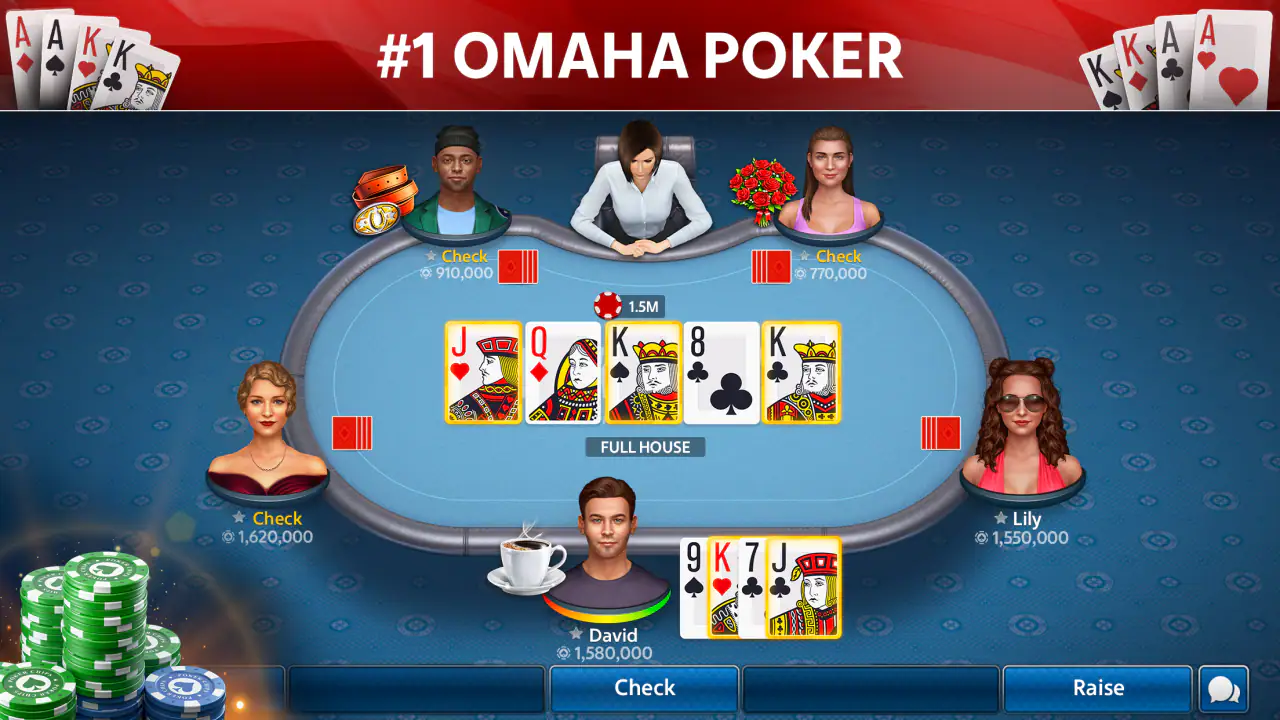
Another useful habit is watching the board before deciding how exciting your own cards are. If the community cards create several possible straights or flushes, a modest made hand may not be comfortable for long. The game becomes more enjoyable when I treat each betting decision as a comparison between my actual hand and the range of hands the table could reasonably hold.
Getting from installation to the first meaningful win
The current version is 75.8.0, and it requires Android 6.0 or later. Once installed, I would not rush straight into aggressive play. The best first setup is mental rather than technical: decide whether you are here for relaxed practice, social competition, or a longer-term poker routine. That choice affects how much attention you should give to the table and how carefully you should handle the game’s optional purchase prompts.
Because the game is free, the initial barrier is low. That makes it convenient for trying a few hands during a commute, while waiting for an appointment, or during a short evening break. The trade-off is that free-to-play card games often make their in-game economy part of the experience. Here, individual in-app purchases range from $0.99 to $999.99, so I strongly recommend deciding in advance whether you intend to spend anything at all.
My practical advice is to separate poker decisions from purchase decisions. Do not buy something simply because a losing streak makes you feel you need to recover momentum. A bad session is usually a reason to pause, review your choices, or leave the table—not a reason to spend. Keeping that boundary makes the free entry point much more comfortable.
The game’s age rating, Teen, also makes this a sensible moment to check device purchase controls if younger family members use the phone or tablet. Even when a player understands poker, the speed of a mobile session can make optional spending feel less deliberate than it would on a desktop.
A simple first-session routine
For a new player, I would use the first session in three stages. First, watch the table flow and learn how quickly decisions arrive. Second, play conservatively enough to see how Omaha hands develop from the opening cards to the final board. Third, choose one hand where you intentionally follow the odds and board texture rather than your first emotional reaction.
That third stage is the first meaningful success I look for. It does not have to be a dramatic pot. If you correctly fold a hand that looked tempting but had poor support, you have already learned something more valuable than a lucky win. If you then win a later pot because you waited for a coordinated draw or a stronger made hand, the result feels earned rather than random.
A particularly useful workflow is to remember the board at the moment you made your decision. After the hand ends, ask whether the later cards genuinely improved your plan or merely happened to rescue it. This prevents a common beginner mistake: rewarding a bad call because the river happened to complete it.
Players who already know poker can make the opposite mistake by playing too quickly. Familiarity with betting patterns does not remove the need to verify the Omaha hand-construction rule. I found that a brief pause before committing was enough to avoid several false assumptions about what my cards could actually make.
How to recognize progress without chasing every table
Progress in this game is not only measured by winning sessions. I would track whether you are entering fewer pots with weak, disconnected holdings, folding more comfortably when the board turns dangerous, and making decisions for a clear reason. Those changes are more reliable than a short run of favorable cards.
One advanced but practical tip is to notice how your attention changes late in a session. When I become impatient, I start treating marginal hands as invitations rather than warnings. That is usually the moment to leave or take a break. Mobile poker is especially good at making “one more hand” feel harmless, even when concentration has already dropped.
Another trade-off concerns table variety. A changing player pool can keep sessions lively, but it also means you may not immediately understand the habits of the people around you. Instead of trying to label opponents after one hand, look for repeated actions: who enters too many pots, who applies pressure consistently, and who becomes cautious when the board changes. A small amount of observation can be more useful than trying to bluff immediately.
Common confusion and where the friction appears
The biggest source of confusion is the difference between having many possible combinations and having a strong playable hand. New players often see several high cards or a possible draw and assume the hand deserves investment. In practice, the cards need to work together, and the board must cooperate. I would rather begin with a hand that has a clear plan than one that offers many vague hopes.
Another point that deserves attention is the emotional effect of social poker. Even without a physical table, the presence of other players can make a fold feel like missing out. That feeling is misleading. Folding is not a failure when the price of continuing is too high or your draw is too thin. In Omaha, disciplined folds are part of the strategy, not a sign that you are playing timidly.
The game can also feel less transparent to people who want a traditional poker simulator. Its appeal comes from the broader player experience, not from being a minimalist rules reference. If your main goal is to study hand probabilities in a quiet environment, a dedicated poker calculator or training tool may be better. If your goal is to sit down, play against a live-feeling crowd, and make decisions under pressure, this title is more appropriate.
Optional purchases are another point of friction. The game is free, but the presence of purchases means the experience is not identical to a completely self-contained card game. I would approach the economy as a boundary-management issue: enjoy the free play, understand what is being offered, and never let a virtual balance dictate how much money you spend.
The wide purchase range reinforces that advice. A small optional transaction and a very large one are presented within the same general model, so users should rely on their own spending limits rather than assuming the free download defines the total cost of playing.
Who will enjoy it most
I think it is best suited to players who already enjoy poker’s uncertainty and want a convenient mobile table. It works particularly well for someone who has learned the basics of Hold’em but wants to develop a more careful understanding of Omaha. The extra complexity gives experienced players room to improve, while the short-session format makes practice easy to fit around ordinary life.
A realistic use case would be an evening when I have fifteen minutes before bed. I can play a focused session, concentrate on selecting better starting hands, and stop after a few meaningful decisions rather than needing to commit to a long match. The same flexibility can work during a break at work, provided the player is comfortable stepping away when the session ends instead of letting the next hand extend the break.
It is less suitable for someone who dislikes competitive pressure, finds poker losses frustrating, or wants a game with no spending prompts. It is also not my first recommendation for a player who has never encountered Omaha and expects to understand every decision instantly. A short rules explanation or a few low-pressure practice rounds would make the learning curve easier.
Players looking for a purely offline experience should choose a different kind of card game. The attraction here is the player-centered poker room feeling, so removing that social element would remove much of what makes the title distinctive.
How it compares with familiar poker alternatives
Compared with a basic Texas Hold’em app, this game asks more of the player before each call or raise. Hold’em can be easier to read because the private-card structure is simpler. Omaha creates more potential hands and more dangerous boards, so it offers deeper decision-making but also more opportunities to overestimate a draw.
Compared with a single-player poker game against predictable computer opponents, the changing table environment is more engaging. The downside is that it may feel less controlled. Computer opponents can be useful for learning hand rankings at your own pace, while a player-focused game forces you to manage timing, uncertainty, and the behavior of people you do not know.
Compared with a poker odds trainer, this is better for applying decisions in a flowing session and worse for isolating one concept at a time. I would use a trainer to understand a difficult probability question, then return here to practice making that decision when the table is moving. The two approaches complement each other rather than serving the same purpose.
Compared with a physical poker night, the mobile format is quicker and more convenient, but it lacks the same face-to-face atmosphere. There is also less natural separation between a casual game and a purchase-driven digital environment. Whether that is a problem depends on what you want from poker in the first place.
My recommendation after learning the rhythm
After getting past the first-session confusion, I found Omaha Poker: Pokerist most enjoyable when I treated it as a decision game rather than a machine for producing constant action. The strongest sessions were not the ones where I played the most hands. They were the ones where I recognized a good starting structure, read the board carefully, and accepted that a fold can be the correct result even after investing time in the hand.
KamaGames has positioned this as a free mobile card game with a broad player audience, and its rating of 4.6 from around 7.7K ratings reflects a generally positive reception. It has also accumulated around 221 written reviews, giving prospective players a useful sense that the game has an established audience rather than being an obscure experiment.
I would recommend trying it if you want Omaha specifically, enjoy social poker sessions, and can keep optional spending under control. Start slowly, learn the hand-building rule before chasing complicated draws, and use your first successful fold as evidence that you are improving. That approach makes the game more rewarding than simply waiting for a lucky combination.
I would skip it if you want a completely offline card game, dislike free-to-play economies, or need a calm teaching tool with no competitive pressure. For everyone else, the free entry makes experimentation easy, while the Omaha format gives the experience enough depth to remain interesting after the novelty of the first few hands fades.
My bottom line: install it for the Omaha experience, not for guaranteed wins. If you stay patient, set a spending boundary, and judge progress by the quality of your decisions, this mobile poker game can become a reliable short-session pastime rather than another app that depends on impulse.
FAQs for Omaha Poker: Pokerist
What is Omaha Poker: Pokerist?
Omaha Poker: Pokerist is a mobile poker game focused on Omaha-style gameplay, where each player receives four private cards and must use exactly two of them together with three community cards to make the best five-card hand. The app is designed for online play, offering virtual tables, tournaments, progression features, and a social casino-style experience rather than real-money gambling.
Is Omaha Poker: Pokerist free to download and play?
Yes, the game can generally be downloaded and played for free on supported Android and iOS devices. It usually includes virtual chips or other in-game resources, while optional purchases may be available for players who want additional chips, bonuses, or faster progression. Because the game uses virtual currency, users should review the purchase settings and avoid spending more than intended.
Can I play Omaha Poker: Pokerist with real money?
Omaha Poker: Pokerist is intended to be played with virtual chips, not as a platform for withdrawing real-money winnings. The poker tables and rewards are part of the app’s entertainment system, so chips earned or purchased inside the game normally cannot be exchanged for cash. Availability, features, age requirements, and purchase rules may vary by country and platform.
Does Omaha Poker: Pokerist require an internet connection?
An internet connection is generally required because the app’s main features depend on online services, including multiplayer tables, account synchronization, tournaments, leaderboards, and in-game events. You may be able to open certain menus or view some content offline, but a stable Wi-Fi or mobile data connection is recommended for smooth gameplay and to reduce the risk of disconnections during a hand.
Is Omaha Poker: Pokerist suitable for beginners?
The game can be suitable for beginners, especially those who already understand basic poker concepts such as blinds, betting rounds, community cards, and hand rankings. However, Omaha has an important rule that players must use exactly two hole cards, which can initially be confusing for Texas Hold’em players. New users should practice at lower-stakes virtual tables and read the in-game guidance before joining competitive games.
Pros
- Pot-limit Omaha rules are easy to learn with clear in-game guidance.
- Fast matchmaking keeps tables active at most times.
- Virtual chips let you practice without risking real money.
- Regular events add variety beyond standard cash tables.
- Customizable avatars and table themes make sessions more personal.
Cons
- Virtual-chip losses can encourage repeated purchases or longer play sessions.
- Some tables may feel unbalanced when experienced players dominate.
- The interface can feel crowded on smaller phone screens.
- Progress and rewards may favor players who log in frequently.
- An internet connection is required for most gameplay features.


